

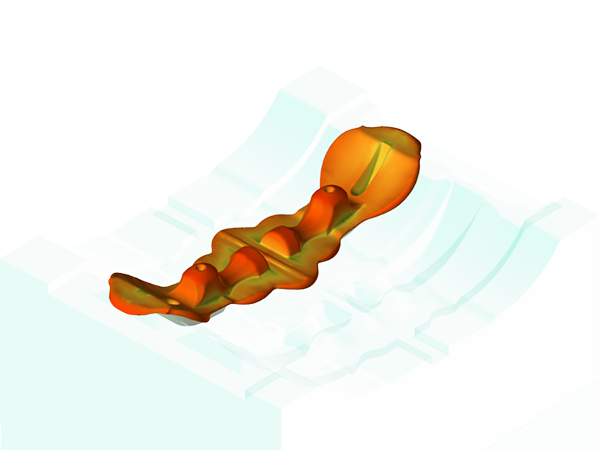
General Metal Forming simulation is the core software for the simulation and optimization of metal forming processes. It forms the foundation of the QForm system and supports a wide range of forming operations within a unified simulation environment.
The module provides universal thermo-mechanical simulation capabilities and can be greatly expanded with specialized QForm modules to address specific process requirements, including:
Extrusion
Rolling
Sheet metal forming
Microstructure evolution
Heat treatment simulation
And other advanced forming technologies
This modular architecture allows users to combine general-purpose forming simulation core with process-specific features, enabling accurate prediction of material flow, temperature distribution, forces, defects, and final part properties across different manufacturing stages.
The new algorithms enable highly efficient use of modern multicore processors and system resources, delivering substantially faster simulations. Because the solver and user interface operate separately yet concurrently, results can be displayed in real time, even during complex simulation runs.
Users can set initial parameters, control the simulation process, and analyze results within a single, integrated interface. A wide range of tools helps users easily define complex technological processes and conveniently explore the extensive data generated by the simulation.
The creation of the finite element mesh and the rebuilding of the mesh during simulation are performed automatically and, as a rule, do not require user involvement.
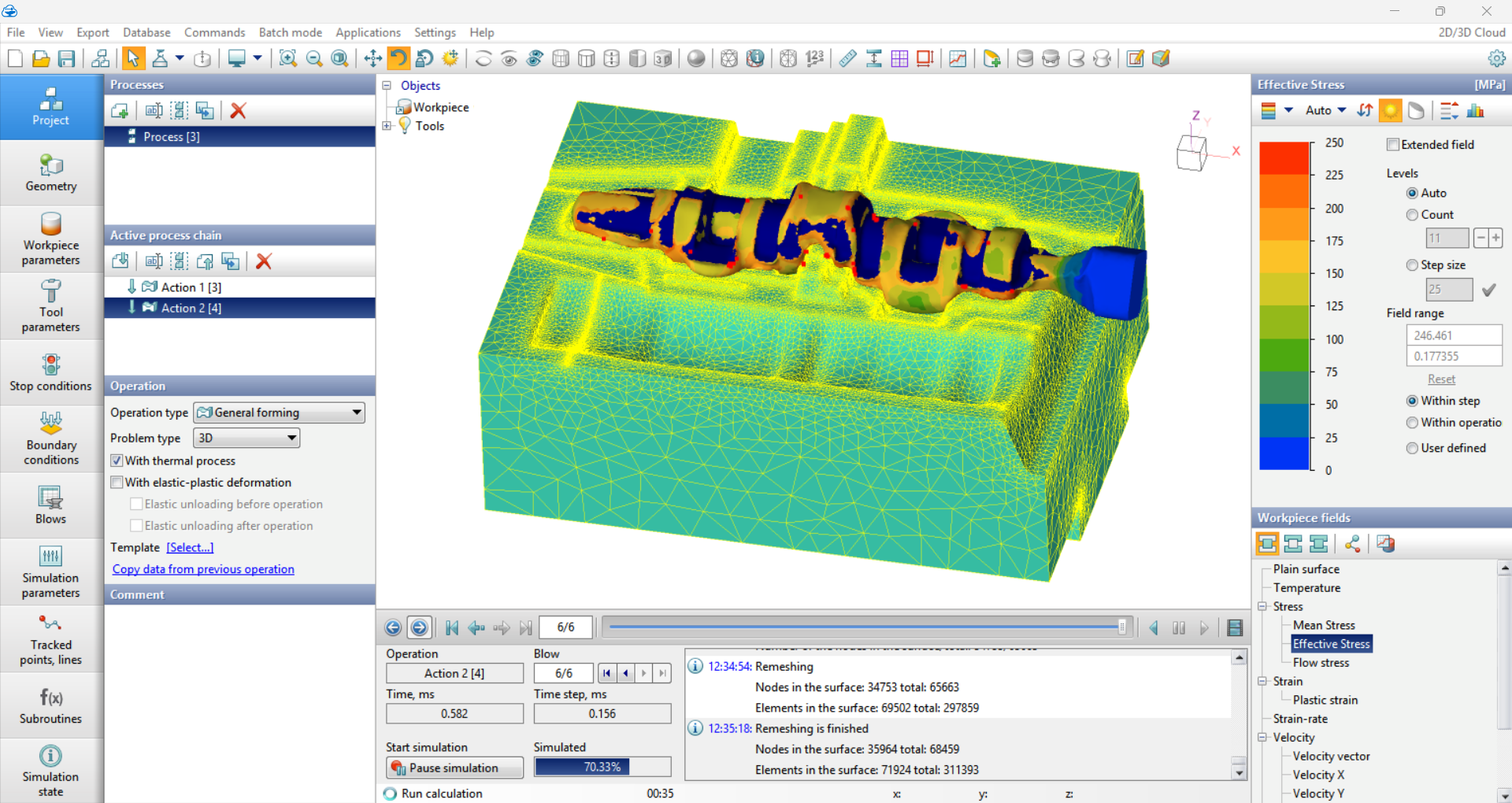
Using subroutines and APIs, QForm helps avoid routine tasks and saves valuable time for specialists, freeing them for creative problem-solving. Simulation results can be presented in an easy-to-understand format using automatically generated templates customized to your company’s standards.
Before implementation of the QForm software the initial forging technology had a flow-through defect. The exact location of the defect was identified by the simulation. The under-surface flow lines in QForm show this defect which is marked out on the photo presented in this video.
By means of the simulation it was easy to understand the reason of defect formation. Then the central part of the die impression was modified to escape the defect. The comparative analysis of the initial and optimized tool geometry is shown in the video.
The second part of the video shows the simulation results for the optimized technology where the defect is not appeared.
Orbital forming is a metal forming process in which a tool rotates on an inclined axis, applying localized deformation to the workpiece. Unlike conventional forging, only a small contact area is deformed at any moment, which significantly reduces forming force and energy consumption.
QForm enables accurate simulation of orbital forming processes and takes into account:
Incremental plastic deformation caused by the rotating and oscillating tool
Complex tool kinematics, including inclined-axis rotation and orbital motion
Contact and friction conditions between the tool and the workpiece
Material flow and strain accumulation, allowing prediction of final geometry and internal structure
Force and torque evolution during forming, useful for machine selection and process control
Using QForm, engineers can analyze stress–strain states, identify zones of excessive deformation, and evaluate the risk of defects such as surface cracking, laps, or incomplete forming.
Lower forming forces compared to conventional forging
Improved dimensional accuracy and surface quality
Optimization of tool geometry and motion parameters
Reduced experimental trials and tooling costs
Drawing is a metal forming process in which a workpiece is pulled through a die to reduce its cross-section and achieve the required shape and dimensional accuracy. The material undergoes plastic deformation under tensile stress, resulting in improved surface quality, dimensional precision, and controlled mechanical properties. Drawing is widely used for the production of wires, rods, bars, and tubes.
QForm enables accurate simulation of drawing processes and takes into account:
Plastic deformation under loading and reduction of cross-section
Material flow through the die, including stress/strain distribution
Contact and friction conditions between the die and the workpiece
Temperature evolution during cold or warm drawing
Drawing load prediction and tool stress distribution, useful for die design and equipment selection
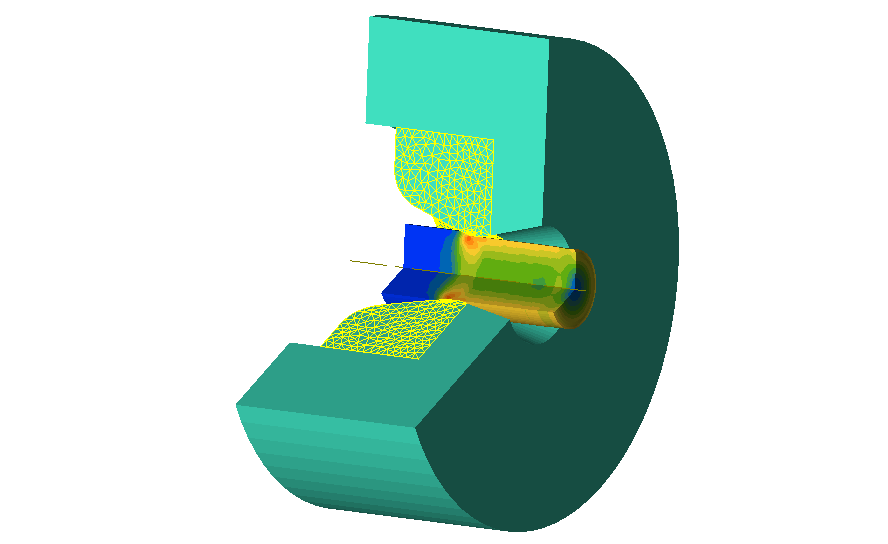
Engineers can accurately simulate drawing processes and predict material flow, stress–strain distribution, temperature evolution, and drawing loads.
Reliable assessment of process stability and final product quality before industrial implementation
Improved dimensional accuracy, enhanced surface quality, and stable production with minimized risk of defects
Conform (Continuous Rotary Extrusion) is a solid-state continuous extrusion process in which a feedstock (rod or wire) is driven by a rotating grooved wheel and forced through an abutment into a die, producing a continuous profile without billet replacement.
QForm simulation of the Conform process accurately takes into account:
Heat generation, which is critical for predicting the self-heating behavior and steady-state temperature regime of the process
Material feeding, accumulation, and redirection through the die
Continuous extrusion conditions, with no billet change, allowing analysis of transient and steady-state stages of production
Thermo-mechanical behavior of aluminum and copper alloys, including temperature-dependent flow stress, strain hardening, and thermal properties
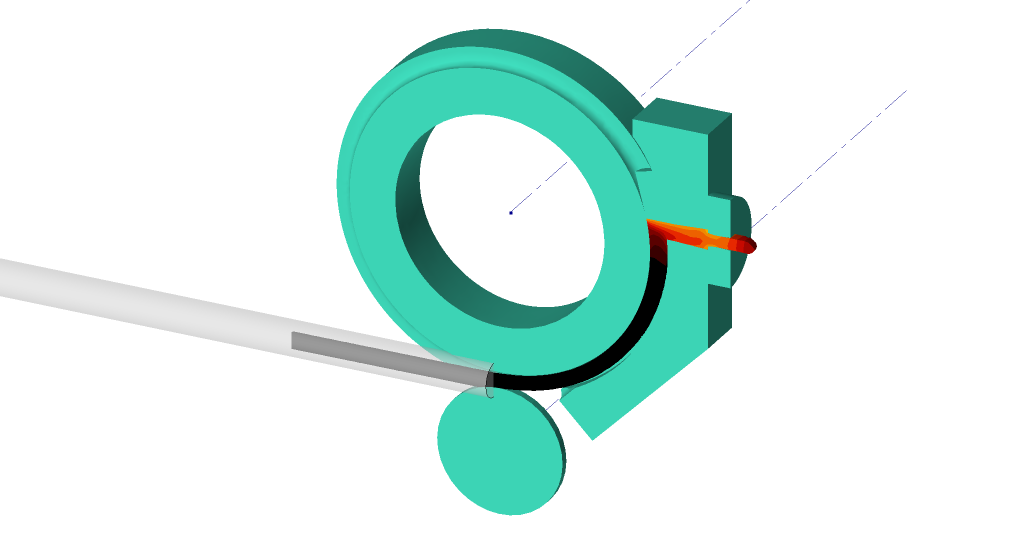
Using QForm, engineers can predict material flow stability, temperature distribution, extrusion forces and torque, and assess the risk of defects, enabling optimization of process parameters and tooling design before industrial implementation.
Prediction of torque, force, and power requirements for proper machine selection
Early detection of potential defects
Optimization of tool geometry and process parameters
Reduction of trial-and-error and production costs
Hydroforming is a metal forming process in which a tube or sheet blank is shaped inside a closed die using high-pressure fluid. The process enables production of complex, lightweight components with smooth surfaces and uniform wall thickness, widely used in automotive, aerospace, and structural applications.
QForm provides a fully coupled thermo-mechanical simulation of hydroforming processes and takes into account:
Material plastic deformation under internal fluid pressure, including large strains and complex stress states
Interaction between the workpiece and the die, with accurate contact and friction consideration
Internal pressure and axial feeding control, allowing analysis of different loading paths
Thickness distribution and thinning prediction
Risk of defects, such as excessive thinning, wrinkling, and insufficient forming
QForm supports simulation of tube or sheet hydroforming, enabling engineers to optimize pressure-time curves, axial feed, and tooling geometry before physical trials.
Reduced trial-and-error during process development
Improved part quality and thickness uniformity
Accurate selection of process parameters and equipment
Lower tooling and production costs
